
 Contact Us

Home Appliance Product Prototyping Services


Table of Contents

Home Appliance Product Prototyping: From CAD Design to Testing
Home appliances should strike a balance between usefulness, safety, attractive design, and performance. Prior to the start of production, teams must verify the fit of parts, the feel of controls, and the behavior of products in the real world. Home Appliance Product Prototyping converts the digital designs into real-life models that expose problems early.
It assists engineers in determining size, materials, assembly, airflow, and access to internal components prior to tooling. In the case of blenders, vacuum cleaners, coffee machines, and air purifiers, a prototype can reveal issues that cannot be displayed on a screen. China Rapid Prototype aids in this effort by CNC machining, 3D printing, vacuum casting, sheet metal fabrication, finishing, and low-volume builds. A clear plan can assist teams to test the features that are right and make good design decisions prior to full production.
The Importance of Prototyping in the Development of Appliances
Home Appliance Product Development is not a simple matter of creating an outer shell. A product can have motors, circuit boards, switches, seals, fasteners, vents, and heating components within a constrained space.
Household Appliance Prototyping provides teams with a physical means of verifying these details. The prototype can show sharp edges, loose clips, fumbling buttons, or panels that bend under stress.
Select the Appropriate Process for Each Prototype
Each appliance part is not compatible with a single process.
3D printing: Can be used to check shapes, complex ducts, button layouts, and ergonomic models. SLA is capable of creating smooth surfaces, whereas SLS is more suitable for more durable components.
CNC machining: Cuts metal or plastic out of solid stock. It is applicable to precise brackets, motor mounts, threaded components, and components that require repetitive assembly.
Vacuum casting: Makes small batches of resin parts using silicone molds. It is able to offer a production-like appearance without hard tooling.
Sheet metal fabrication: Cuts, bends, and joins support brackets, frames, covers, and heat shields.
Injection molding and rapid tooling: Applicable to molded samples and testing a route to greater volume production.
Design Parts Round Real Use
Home Appliance Engineering begins with the environment that a product will encounter. A kitchen appliance can be exposed to heat, moisture, food stains, vibration, and frequent cleaning. A vacuum cleaner should have impact resistance, secure joints, airflow, and easy-to-empty parts.
- These needs must be reflected in the choice of materials. ABS can fit most rigid housings, and polycarbonate may be used to offer impact strength or clarity. Aluminum is used in stiff and lightweight structures and for heat transfer.
- Where cleaning is important and corrosion resistance is important, stainless steel assists. The last option should be appropriate to anticipated temperature, load, chemical contact, and safety requirements.
- Home Appliance Housing Prototype Design must consider wall thickness, ribs, bosses, snap fits, and draft angles. Lack of uniformity in the walls may distort during molding.
- Thin ribs can be broken, and bosses in a bad location can crack when screwing them together. Design for Manufacturing (DFM) reviews are used to detect risks prior to tooling. Engineers also test the ability of tools to access features and parts to be removed from molds.
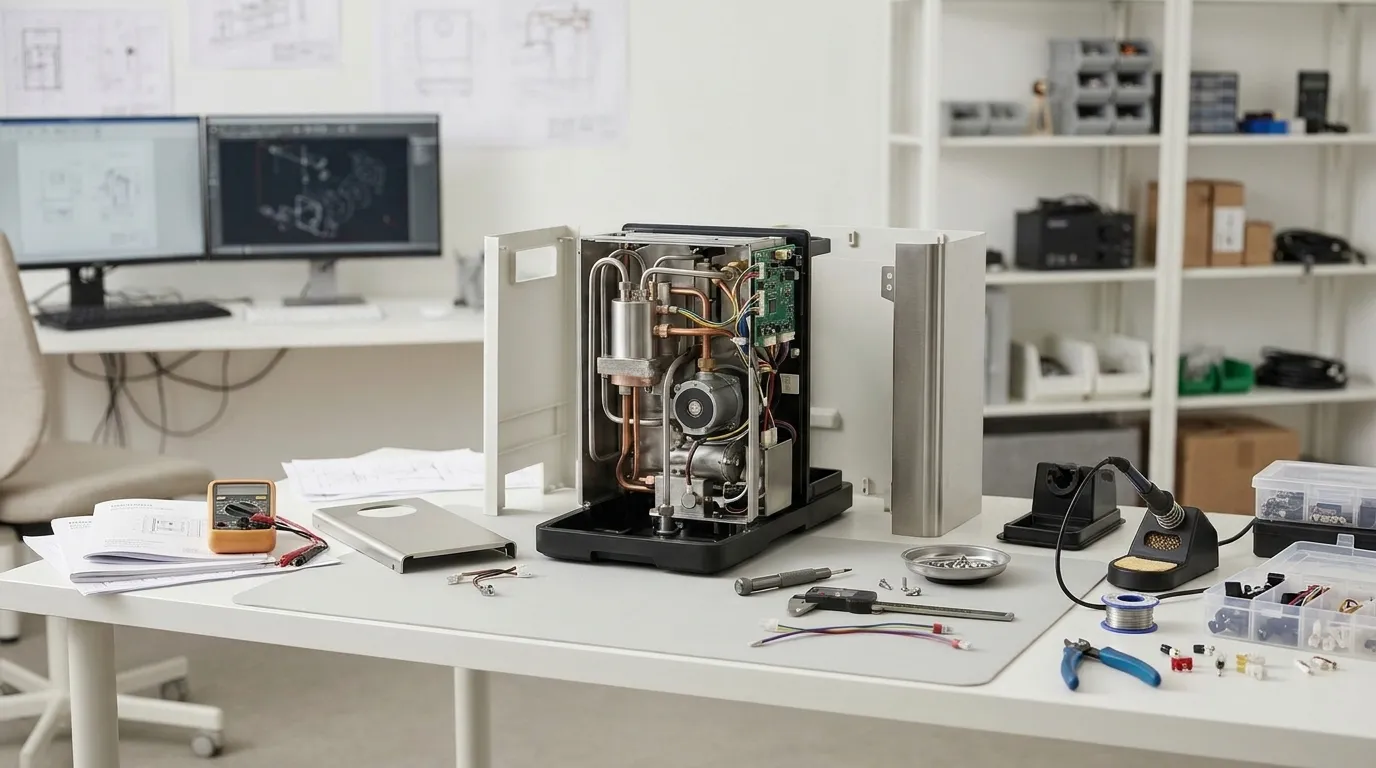
CAD Model to Functional Prototype
- Appliance Prototype Development based on CAD Models starts with 3D files and requirements. STEP or STP files are common formats for sharing solid geometry.
- Critical dimensions, tolerances, threads, and surface finish should be defined in technical drawings. Clear datums assist the inspectors in measuring parts based on similar reference points.
- Home Appliance Functional Prototypes: Button travel, latch strength, handle comfort, mounting points, airflow, and simple movement can be tested.
- They do not necessarily guarantee electrical safety or durability. Mains electricity, heating, pressure, or moving-blade tests will need appropriate controls and qualified personnel.
Test, Learn, and Refine Before Production
Consumer Appliance Prototype Testing ought to be based on a written plan. The question must be set first, followed by the selection of the test, and the result should be recorded. A review may cover:
- Fit and assembly: Check gaps, fasteners, cable routing, and service access.
- Use and comfort: Review grip, reach, noise, button force, and cleaning access.
- Thermal performance: Measure temperatures near motors, heaters, vents, and nearby materials.
- Mechanical strength: Check clips, hinges, handles, mounts, and components that are subjected to vibration.
- Airflow and sealing: Check ducts, vents, filters, gaskets, and undesirable leaks.
Custom Home Appliance Prototype Development is most effective when the teams exchange feedback in a short time. Revise the CAD model, document every change, and develop the next version based on high-risk issues.
Check Control Cost No Key Checks Skipped
Cost-Effective Home Appliance Prototyping translates to money on evidence. Low-cost 3D printing can be used in early shape models, whereas components that are exposed to loads or heat might require more robust materials and accurate processes. Do not machine all parts out of fine stock when a less complicated model will answer the question.
- Small Home Appliance Product Development might require few parts initially, but complex assemblies might require multiple rounds. Provide the manufacturer with the quantity, material, finish, tolerance, and test conditions.
- Home Appliance Design and Prototype Manufacturing ought to look ahead. When a design is to be injection molded, examine wall thickness, draft, undercuts, and parting lines prior to tooling. In the case of pilot builds, ensure that suppliers are able to repeat important dimensions and finishes. The home appliance prototyping service by Yanmee includes the housings, control panels, brackets, airflow parts, and other similar items.
Conclusion
When a problem is revealed early enough to be corrected, a prototype is useful. Powerful teams challenge appearance, fit, function, materials, and manufacturing requirements as interrelated questions.
Yanmee is capable of serving teams that require physical parts to review, perform assembly checks, or low-volume builds. Go to the home appliance prototyping page to talk about your project, present CAD files, and get a quote. Develop the evidence your team requires before investing in production tooling.
- PREV: Null
- NEXT: Null
Talk to the Manufacturer, Not a Middleman
Resources & Insights
-
Blog
Household Appliance Prototyping Services: From Concept to Market-Ready Products
2026-10-26By -
 Blog
Rapid Prototyping 3D Printing- Methods, Materials, Process and How to Choose
2026-10-23By -
 Blog
Sheet Metal Forming - Processes, Materials, Thickness and Design Guide
2026-10-23By -
 Blog
Low Volume Appliance Manufacturing Methods and Processes
2026-10-23By


