
 Contact Us

Prototype Manufacturing for Appliances | Guide


Table of Contents

Prototype Manufacturing for Appliances: From Design to Testing
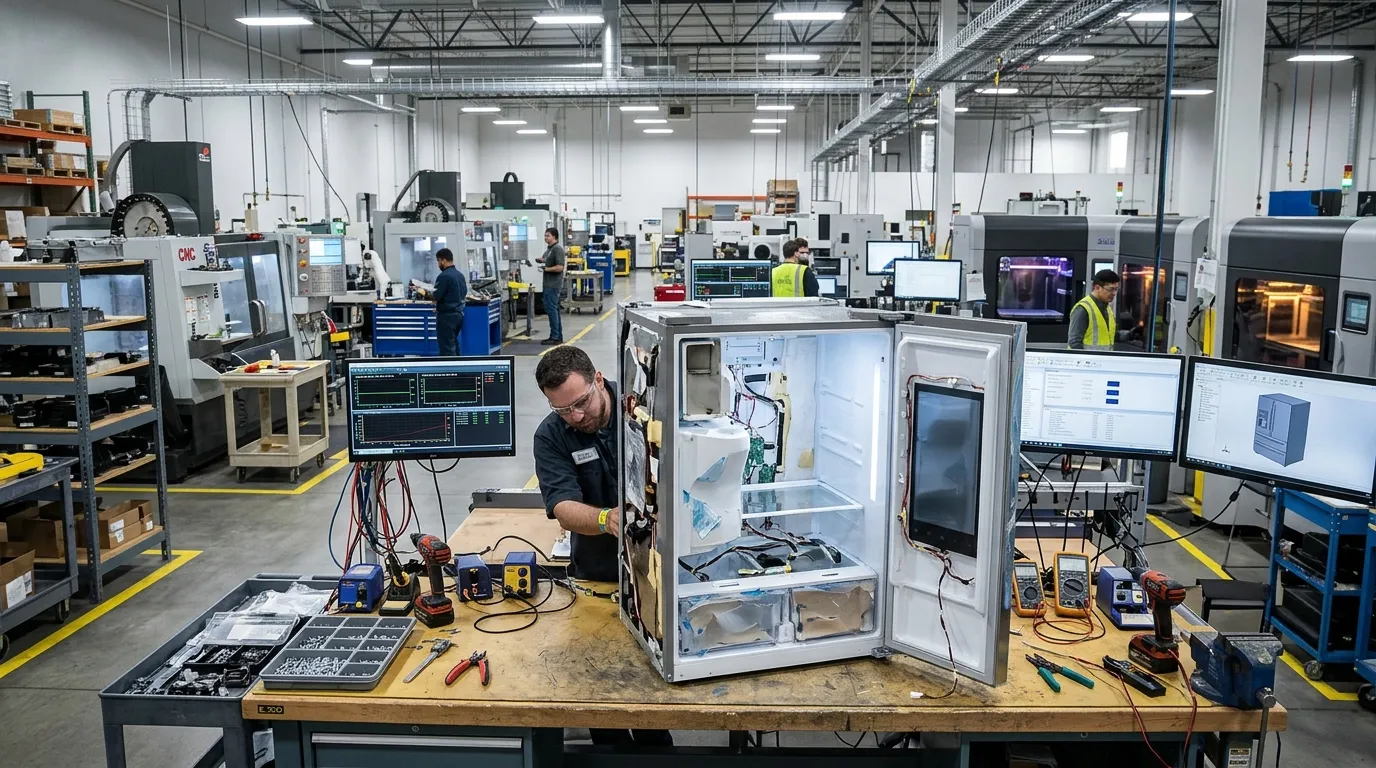
A CAD model may appear finished but fail when assembling or in normal operation. Components can be incompatible, buttons can be hard, or heat can accumulate around delicate parts. Physical models expose faults prior to the start of production tooling. Prototype Manufacturing of Appliances connects design, materials, and part making and testing.
A vacuum cleaner, coffee maker, or blender may include plastic shells, metal brackets, motors, circuit boards, seals, and moving parts. Every component should be able to fit into a small area and address strength, heat, and safety requirements. Appliance Prototype Manufacturing allows engineers to test these specifications with actual parts.
Design the Prototype According to its Purpose
Specify what the prototype should demonstrate. An appearance model verifies shape, color, texture, and handling. A layout and dimension check is done by an engineering model. A working prototype can be required to sustain airflow, movement, heat, or repetition.
Established standards of size, weight, material, finish, quantity, and test conditions. Mark critical dimensions, such as screw holes, bearing seats, sealing faces, and mating parts. Tolerances are not to be a single blanket figure, but rather an expression of the role of each feature.
Select an Appropriate Production Process
Home Appliance Prototyping CNC Machining
CNC machining is a process that cuts a solid block with cutting tools. It is applicable to components that require precise holes, flat faces, threads, and mounting points. It can be utilized by engineers in motor brackets, gear housings, control knobs, metal frames, and supports related to heat.
Aluminum is applicable in cases where low weight and high machinability are important. ABS, polycarbonate, and POM may be used in various plastic prototype applications, based on impact, heat, friction, and dimensional stability. The choice of material should be appropriate to the test. A machined plastic component can verify fit but might not act like a molded production component.
Household Appliance Prototyping 3D Printing
In 3D printing, a part is created based on a digital model in layers. FDM is capable of making larger concept parts, whereas SLA is capable of making smooth shapes. SLS can be applied to complicated components that require greater support during printing.
These techniques assist in checking housing form, cable pathways, airways, buttons, and assembly access. Ergonomic tests are supported by printed parts, whereas the direction of the layers and material constraints influence strength under load or heat.
Vacuum Casting and Sheet Metal Fabrication
Vacuum casting is a small-batch process for plastic-like components using a master model and silicone mold. It can be used in housings or control panels to check the fit and review by the user. Functional testing should be preceded by checking resin heat and strength limits.
Sheet metal fabrication is applicable to brackets, covers, and frames. Trial parts are made by laser cutting and CNC bending without full tooling. Select by geometry, material, quantity, and test purpose.
Appliance Design to Prototype Manufacturing
Home Appliance Prototype Development is most effective when design files and manufacturing plans are looked at simultaneously. Wall thickness, ribs, screw bosses, snap fits, draft angles, and clearances in assembly should be displayed in CAD models. The engineers should also verify cable routes, motor mounts, vents, and service access.
- Design for Manufacturing (DFM) flags indicate characteristics that can lead to production problems. Lack of evenness in the walls may lead to sink marks or warping, and inadequate draft may result in molded parts being difficult to release. Tooling changes are more difficult than early changes.
- The home appliance prototyping service offered by Yanmee includes CNC machining, 3D printing, vacuum casting, sheet metal fabrication, finishing, and low-volume prototype production. Its team is able to look at CAD files and the purpose of use to assist in choosing an appropriate process.
Test Fit, Function, and Safety
The Appliance Product Prototyping must have checks that are related to actual use. Begin with dimensional inspection and assembly tests. Check alignment, fasteners, panel closure, and control movement. Check gaps around removable tanks, lids, and filters.
Testing can include:
• Checks of key mounting characteristics.
• Assembling internal components trials.
• Fan and vent airflow checks.
• Checking of heat around motors and circuit boards.
• Checks of vibration and noise.
• Repeat use of buttons, hinges, latches or switches.
A prototype test is not a complete product test. Electrical safety, insulation, fire risk, and other checks should be in accordance with the rules which apply to the product and target market.
Plan Low-Volume Builds and Production
- Low-Volume Production of Appliance Prototypes may assist teams to create a small batch to pilot assemble, user test, or early market test. Vacuum casting can be used in small batches of appearance parts, whereas CNC machining can be used in small batches of parts with limited quantities. Injection molding can be used to produce repeatable plastic components when demand is high.
- Check material, volume, finish, draft, undercuts, gate position, and shrinkage before placing an order for a mold. ABS, PC, PP, or PA may be used in injection molding. The choice of resin is based on the impact strength, heat, chemical contact, and appearance.
Find out about rapid prototyping services to check early, or injection molding services to repeat production. Provide STEP files, drawings, materials, quantity, and critical dimensions to get a quote.
Eliminate Typical Prototyping Blunders
Teams can be misled by the selection of a process based solely on speed or price. The low-cost model might not act like the finished material. There is also no variation between parts when testing one sample.
Determine important features and test them during each build. This helps Appliance Prototype Development Services connect problems with design or process modifications.
Conclusion
The first step to a reliable appliance is to have clear test goals, appropriate materials, and job-made prototypes. CNC machining, 3D printing, vacuum casting, and sheet metal fabrication are solutions to various design questions. Good testing transforms those results into workable changes prior to the acceptance of production tools.
Contact Yanmee to discuss your CAD files, quantity of prototypes, materials, and testing requirements, and select a process that fits your next development step.
- PREV: Null
- NEXT: Null
Talk to the Manufacturer, Not a Middleman
Resources & Insights
-
Blog
Household Appliance Prototyping Services: From Concept to Market-Ready Products
2026-10-26By -
 Blog
Rapid Prototyping 3D Printing- Methods, Materials, Process and How to Choose
2026-10-23By -
 Blog
Sheet Metal Forming - Processes, Materials, Thickness and Design Guide
2026-10-23By -
 Blog
Low Volume Appliance Manufacturing Methods and Processes
2026-10-23By


